Organisation & founder

About RED

RED brings together soil regeneration, practical development, education, documentation and consulting in one shared, founder-led organisation.

Clear responsibility, connected work

RED is founded, developed and led professionally by Alexander. His vision and long-term values provide the binding framework. Collaborators, external specialists and participants can contribute knowledge and experience; strategic responsibility and the direction of development remain clearly assigned.

The RED Method connects four branches. They operate economically and organisationally under one shared name while each retaining a clear purpose.

The RED Community sits within the Media branch. Media is responsible for its operation, moderation and development; the platform serves all four branches as a shared space for exchange and connections.

Vision

A regenerative future needs living foundations

RED works towards a future in which soils are seen not merely as production areas or technical substrates, but as complex habitats. Water, vegetation, animals, fungi, microorganisms and human action are understood as interconnected parts of a system.

Regeneration does not mean returning to an idealised former state. It means creating conditions under which a site can once again develop greater biological activity, diversity, water retention and resilience.

Mission

Understand, apply, document and share

RED combines site-specific practice with careful observation, scientific context, education and consulting. Knowledge is developed through real tasks and presented in a form that enables others to transfer it to their own conditions.

The organisation remains as simple as possible. New roles, services and collaborations arise only when there is a real task, clear responsibility and viable funding.

The four branches

Different purposes, one shared technical framework

Each branch carries the RED Method into practice, public communication and application in its own way. Findings flow continuously between them.

Branch 01

Media

Documents initial conditions, work, progress, setbacks and findings. This produces blog articles, films, conversations, newsletters, guides and later more extensive publications. Media is also responsible for operating, moderating and developing the RED Community.

Branch 02

Project: Fertile Earth

Creates a long-term place for practice, monitoring, research and learning. The RED Method is applied, assessed and carefully developed there.

Branch 03

Academy

Translates findings into accessible digital content, webinars and small in-person courses. Learning connects foundations, practical work, observation and reflection.

Branch 04

Consulting & Planning

Supports interested individuals, people responsible for land, farms and institutions with site analysis, prioritisation, implementation and transparent monitoring.

Feedback

The branches operate as a learning cycle

01 · Practice

Real questions arise

Specific tasks, limitations and observations emerge at the site and in consulting projects.

02 · Assessment

Data are placed in context

Observation, field testing, laboratory analysis and literature are distinguished according to the strength of their evidence.

03 · Documentation

Knowledge becomes visible

Media records development and context and also makes uncertainty and corrections transparent.

04 · Communication

Findings become shareable

The Academy and Consulting translate knowledge into formats for learning and action.

05 · Feedback

The Method learns

New experience flows back into research questions, priorities and the further development of the RED Method.

Organisation

Founder-led and open to collaboration

  • Clear responsibilityAlexander bears overall strategic and professional responsibility. Responsibilities are not obscured by unnecessary committees.
  • Professional collaborationExternal specialists, laboratories, research partners and practitioners can complement individual questions, analyses and projects.
  • Task-based participationA team grows only when there is concrete work, funding and a clearly defined area of responsibility.
  • Transparent limitationsThe website clearly distinguishes what is planned, being prepared or already implemented.
Funding

Diversified, phased and tied to real services

Development should not depend on a single source of revenue. Each form of funding supports a clearly defined part of the work.

Subscription

In-depth knowledge

Monthly premium access supports long-form articles, protected materials and the later Telegram group.

Service

Consulting & Planning

Fee-based assignments finance site-specific analysis, concepts and support.

Education

Courses & webinars

Participation fees cover preparation, support, materials and actual delivery costs.

Development

Funding & support

Suitable grants, collaboration and voluntary support can enable defined development steps.

Voluntary support remains unambiguous

Voluntary payments support the development of the company and are not described as charitable donations. Purpose, consideration and legal framework are stated clearly for every offering.

Stages of development

Growing when the foundation can support it

Stage 01

Digital foundation

The website, blog, premium content, documentation and initial consulting formats are built reliably.

Stage 02

Economic stability

Recurring revenue, clear processes and legal foundations create planning security.

Stage 03

Secure the site

Project: Fertile Earth begins only when land, water, law and funding have been clarified on a viable basis.

Stage 04

Deepen practical work

Monitoring, courses, collaboration and further publications grow from the actual work at the site.

Legal form and registered address will be developed step by step

RED will initially be built through a for-profit company. The long-term vision is a non-profit-oriented limited-liability company in Switzerland once the work, funding and legal requirements can sustain that step. Binding registration, address and tax details will be published only when they genuinely exist.

From the organisation to the founder

The structure follows a personal set of principles

The organisation can only be fully understood when its founder’s motivation is also visible. The following section describes Alexander Maier’s path, his professional principles and the responsibility from which RED emerged.

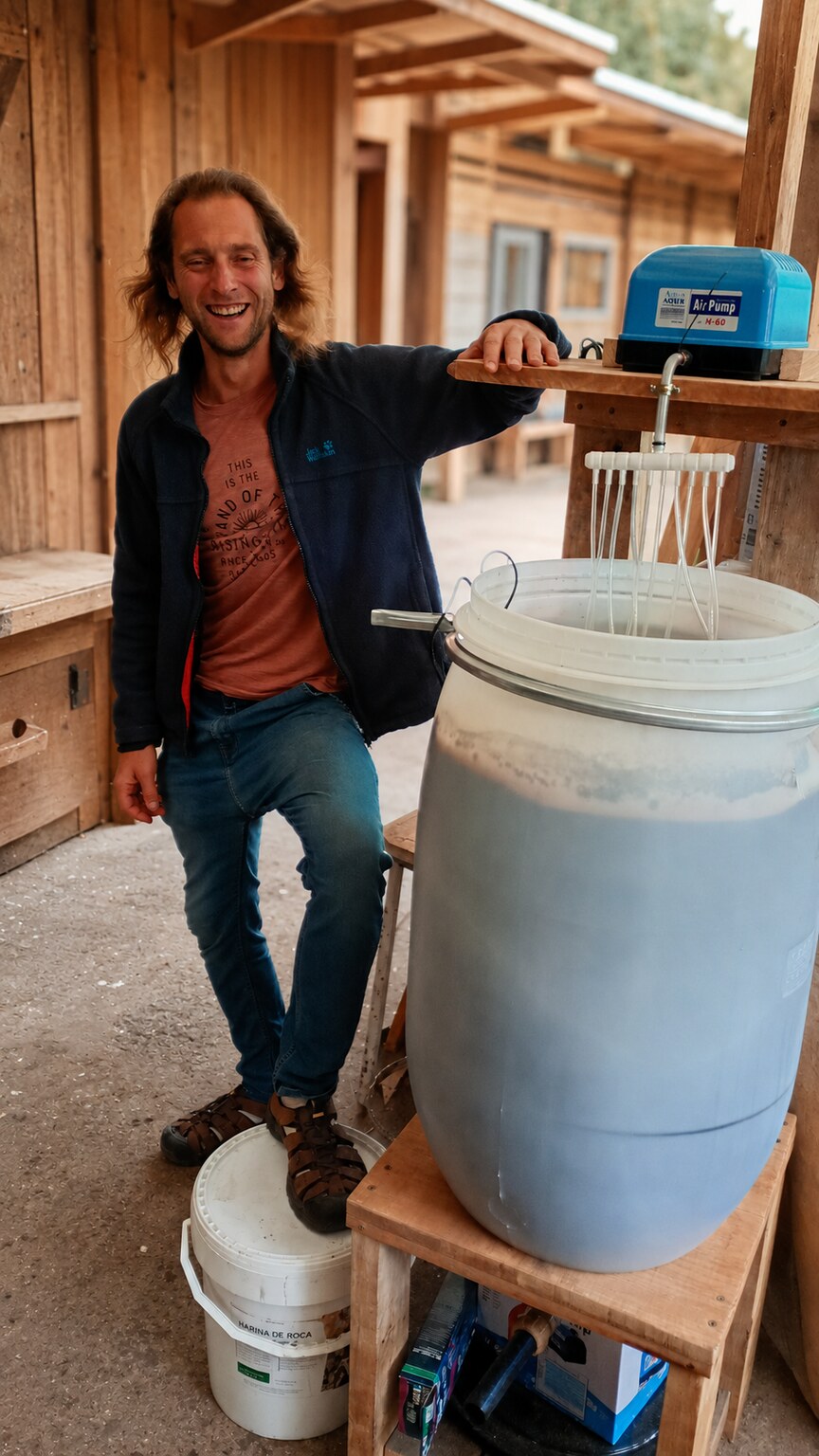
Alexander Maier beside a self-built aerated compost tea reactor
Alexander with a self-built aerated compost tea reactor.
Maier, Alexander

About the founder

RED did not begin with a finished business model, but with a personal transformation. Alexander comes from Upper Bavaria. Over the course of his life, he developed a deep awareness of how closely humanity’s future is connected to the health of our soils and ecosystems.

The starting point was an honest realisation: for a long time, he had lived without truly understanding natural cycles or the consequences of his own actions. Alexander uses the image of the grasshopper and the bee to describe this change. The grasshopper consumes without contributing to the continuity of the system. The bee also takes what it needs to live, yet in doing so supports the larger whole.

“I want to build more humus than is lost through my life and actions.”

This decision led to an intensive engagement with living soils, plants, animals, fungi, microorganisms and the complex relationships within natural ecosystems. Since then, practical fieldwork and continuous scientific inquiry have been inseparable for Alexander.

The central conviction

People create the conditions

At the heart of RED is an understanding of soil fertility that cannot be reduced to individual products, measures or short-term solutions. Plants, animals, fungi and microorganisms form a living network. People do not build humus directly. They can, however, create the conditions under which a functioning soil ecosystem carries out this work.

The task is therefore not to seek complete control over this network. It is to understand its relationships more clearly, provide beneficial impulses and accompany its development attentively, responsibly and with the necessary patience.

The experience gained on La Gomera has strongly shaped this approach. It showed how soil loosening, vegetation cycles, organic materials and support for soil life can interact – and, at the same time, how important it is not to treat observations prematurely as universally valid proof.
Influences and learning path

Knowledge remains in motion

Alexander does not see himself as someone in possession of complete and final knowledge. Living ecosystems do not follow a rigid blueprint. They develop through relationships, adaptation, diversity, observation and time.

Martin Sichler from Übersee am Chiemsee had an important influence on this path. Through his enthusiasm, spirit of discovery and practical work on his farm, in his greenhouses and on his cultivated land, he gave Alexander decisive impulses for his present understanding of soil fertility and regenerative development.

RED is therefore conceived as a learning system. Practical experience, scientific findings, measurements, setbacks and corrections are brought together. Where knowledge is uncertain or data are missing, this should remain visible. Credibility does not arise from claiming to have an immediate answer to every question, but from a willingness to look closely and review one’s own actions.

Principles

Working with nature

Sites are read and processes supported instead of forcing living systems into rigid formulas.

Responsibility

Choosing our footprint consciously

Our actions should help future generations inherit more living soils and more resilient ecosystems.

Transparency

Remaining traceable

Decisions, limitations, errors, measurements and adjustments all belong in complete documentation.

Development

Growing step by step

RED remains on a scale that Alexander can support reliably in technical, organisational and practical terms.

RED’s purpose

Connecting practice, knowledge and responsibility

RED develops and documents a site-specific approach to regenerating degraded soils. In the long term, Project: Fertile Earth is intended to provide a real place for practice, research and learning. Initial conditions, measures, vegetation development and soil processes will be observed over many years and interpreted transparently.

The RED Method provides the shared technical framework. Media makes development visible and presents findings in an accessible way. The Academy translates them into learning formats. Consulting and Planning support people and organisations in developing their own land under their own responsibility.

The four branches are not separate individual projects. Observations from practice flow into documentation, education and consulting; questions from those fields in turn lead to new observations and the careful further development of the Method.

Our understanding of success

Impact before size

RED aims for economically viable growth that supports the regeneration of soils and ecosystems. Through education, consulting, digital offerings and collaboration, it aims to reach more people and independent projects. The team and structures can be developed further as demand grows and funding is secured. Professional quality, ecological responsibility and RED’s long-term values remain the guiding criteria. Success means that soil processes are understood more clearly, decisions are made more carefully and regenerative developments become viable over the long term.

People should not merely adopt knowledge, but transfer it to their own conditions, observe the results and develop it responsibly. RED’s central site is intended as a long-term reference project and place of learning – not as a template to be copied everywhere without adaptation.

The vision deliberately remains grounded: a real place, robust documentation, accessible education, responsible consulting and a growing body of knowledge that follows actual development.

Invitation

RED is being built. Many ideas will be developed, examined and improved over the coming years. Anyone interested in regenerative soil ecosystems is invited to accompany this path – as a course participant, research partner, landowner, supporter or through the joint implementation of a carefully planned project.